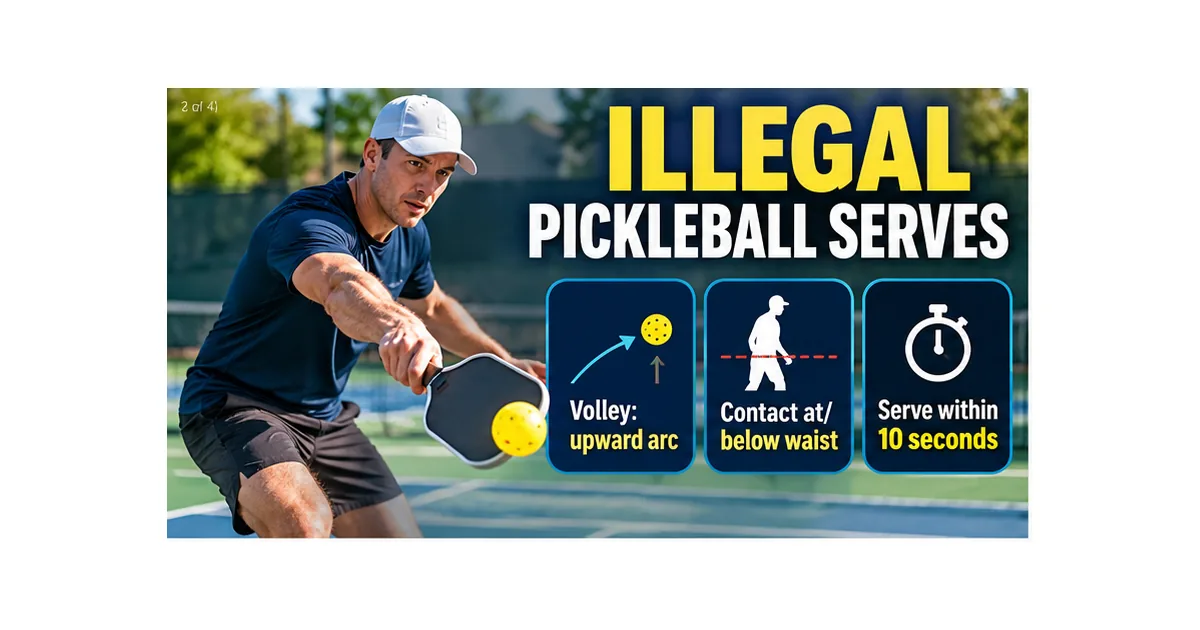
Illegal pickleball serves include volley serves hit above the waist, serves made without a clear upward motion, serves with the paddle head above the wrist at contact, and serves made from an illegal foot position. A drop serve has different motion rules, but the ball must be released correctly before it bounces.
In This Article
- What are illegal pickleball serves?
- Which volley serves are illegal?
- What makes a drop serve illegal?
- Can your feet make a serve illegal?
- Where must a legal serve land?
- Can you spin the ball before serving?
- How long do you have to serve?
- How to avoid an illegal serve
- FAQs about illegal pickleball serves
Knowing the difference matters because an illegal serve can cost the serving side the rally.
What are illegal pickleball serves?
An illegal pickleball serve is a serve that breaks the serving requirements in the official rules.
The exact violation depends on whether you use a volley serve or a drop serve. The volley serve has three specific requirements at the moment the paddle contacts the ball:
- The serving motion must move in a clear upward arc.
- The paddle head cannot be above the highest part of the wrist.
- The ball cannot be contacted above the server’s waist.
The drop serve does not have those three restrictions after the ball bounces. This is one reason players sometimes mistakenly call a legal drop serve illegal.
Which volley serves are illegal?
A volley serve is made by striking the ball before it bounces. Under current USA Pickleball rules, several common serving motions can make it illegal.
Contacting the ball above the waist
The ball must not be clearly above the server’s waist when paddle contact occurs, according to Forbes.
This prevents a player from using a high contact point similar to an overhead tennis serve. A low-to-high swing does not make the serve legal if the ball itself is contacted too high.
Raising the paddle head above the wrist
At contact, the highest point of the paddle head must not clearly be above the highest part of the server’s wrist joint.
Players can still use different grips and swing paths. The important point is the paddle’s position at the instant of contact.
Using a flat or downward swing
The paddle must travel in a clear upward arc as it contacts the ball.
A sideways slap, flat drive, or downward chopping motion can therefore become an illegal volley serve even when the ball is contacted below the waist.
What makes a drop serve illegal?
A legal drop serve starts by releasing the ball from a natural, unaided height and allowing it to bounce before hitting it, according to Wikipedia.
The server may not:
- Throw the ball downward to create a higher bounce.
- Toss the ball upward before the bounce.
- Propel the ball in another direction before it lands.
- Add prohibited manipulation or spin during the release.
After the bounce, the volley-serve requirements concerning contact height, paddle-head position, and upward swing do not apply.
There is also no restriction on where the ball bounces on the playing surface before it is struck.
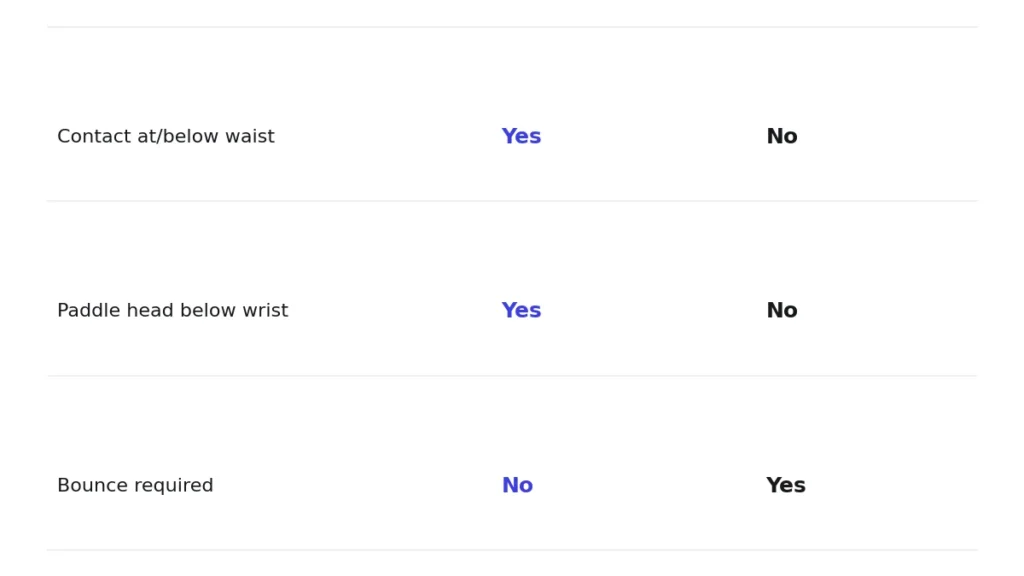
| Serve type | Upward arc required? | Contact below waist? | Paddle head below wrist? | Bounce required? |
| Volley serve | Yes | Yes | Yes | No |
| Drop serve | No | No | No | Yes |
Can your feet make a serve illegal?
Yes. A perfectly legal swing can still result in a service fault because of the server’s foot position.
When the ball is struck, the server must have at least one foot on the playing surface or ground behind the baseline. The server’s feet cannot touch:
- The baseline.
- The court inside the baseline.
- The area beyond the imaginary extension of the sideline.
- The area beyond the imaginary extension of the centerline.
These restrictions apply to both volley serves and drop serves.
A common mistake is stepping onto the baseline just before paddle contact. What matters is the player’s position at the moment the serve is struck.
Where must a legal serve land?
The ball must travel diagonally into the opponent’s correct service court.
A serve is a fault if it lands:
- In the non-volley zone.
- On a non-volley-zone line.
- Outside the correct service court.
A serve may touch the net and remain legal if it continues into the proper service court. Other service-court boundary lines can be considered in.
This means touching the net by itself does not automatically make a serve illegal.
Can you spin the ball before serving?
You cannot deliberately manipulate the ball to add prohibited spin during its release.
Natural rotation during a normal release can occur, but intentionally creating spin with the hand before striking the ball is different. Spin can still be generated through paddle contact with the ball.
This rule applies to the ball release rather than banning spin serves altogether.
How long do you have to serve?
The server must serve within 10 seconds after the score is called.
Failing to serve within that period is a fault under the current 2026 rules. USA Pickleball has received a proposal to change this rule for 2027, but that proposal does not change the rule currently in force.
Players should therefore continue following the 10-second requirement unless a later official rulebook changes it.
How to avoid an illegal serve
Most serving faults can be avoided with a simple routine:
- Stand clearly behind the baseline and inside the extensions of the sideline and centerline.
- Release the ball without deliberately adding spin.
- For a volley serve, keep the contact point at or below waist level.
- Keep the paddle head from rising above the wrist at contact.
- Swing upward through the ball.
- For a drop serve, let gravity create the bounce rather than throwing the ball.
- Aim diagonally beyond the non-volley zone into the correct service court.
- Serve within 10 seconds of the score being called.
If the volley-serve mechanics feel difficult to judge, using a drop serve removes the three volley-specific swing restrictions.
FAQs about illegal pickleball serves
Is an overhand pickleball serve illegal?
Yes, a traditional overhead serve is illegal under USA Pickleball rules because a volley serve must meet the required upward motion, paddle-head position, and contact-height conditions. A tennis-style overhead serve does not satisfy those requirements.
Can you serve above your waist in pickleball?
Not with a volley serve. The ball cannot be clearly above the waist when it is contacted, while that contact-height restriction does not apply after a legal drop serve has bounced.
Is a sidearm serve legal in pickleball?
A sidearm-looking serve can be legal if it still satisfies every volley-serve requirement. If the paddle is not moving in a clear upward arc or the contact position violates the other requirements, it becomes a fault.
Is a backhand serve legal in pickleball?
Yes. Both forehand and backhand serves are permitted as long as the chosen serve meets the applicable rules for a volley serve or drop serve.
Conclusion
Illegal pickleball serves usually come from incorrect volley-serve mechanics, an improper ball release, or a foot-position violation. Learn the separate rules for volley and drop serves, and illegal pickleball serves become much easier to recognize and avoid.