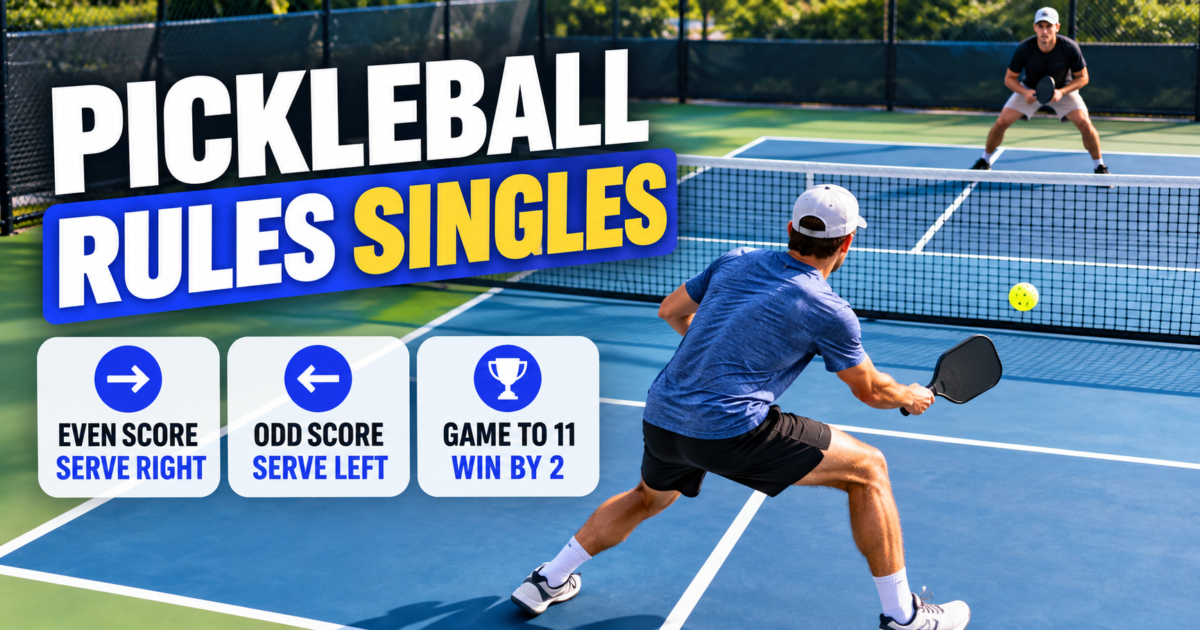
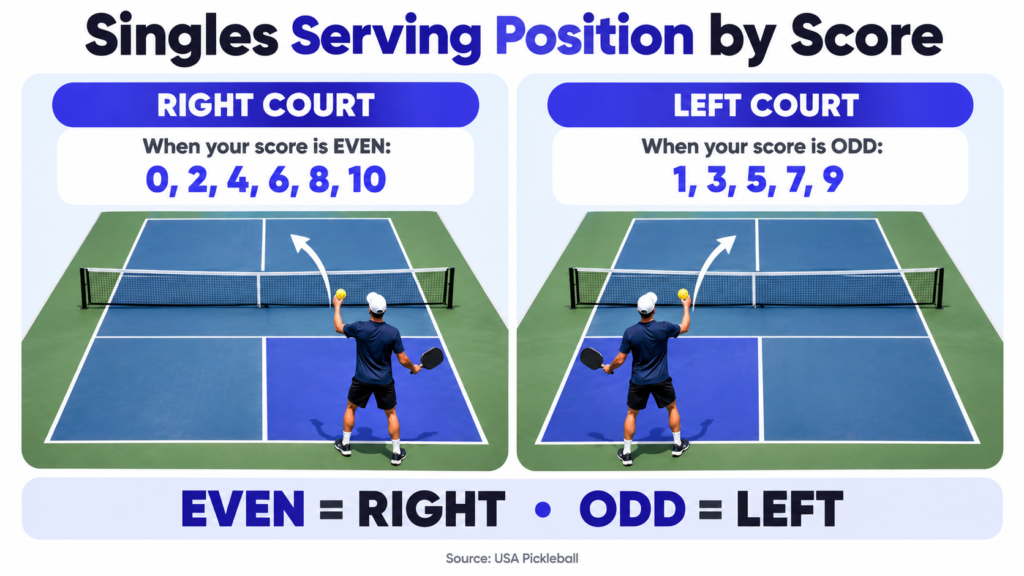
Pickleball rules singles are similar to doubles rules, but each player covers the entire side of the court and there is only one server per side. In traditional scoring, you score only while serving, serve from the right when your score is even and the left when it is odd, and usually play to 11 points while winning by at least two.
USA Pickleball publishes the official rules and updates its rulebook each year. The current 2026 rulebook is the governing reference for sanctioned play.
Pickleball rules singles basics
Singles pickleball is played one player against one player on the same 20-by-44-foot court used for doubles, according to Wikipedia. Unlike tennis singles, there are no narrower singles sidelines in standard pickleball.
The main rules are:
- Serve diagonally into the opponent’s service court.
- Let the serve bounce before returning it.
- The serving player must then let the return bounce.
- After those two bounces, either player may volley or play the ball after a bounce.
- Do not volley while touching the non-volley zone, commonly called the kitchen.
- In traditional scoring, only the server can score.
- A standard game is commonly played to 11 points, win by two.
How serving works in singles
A singles game starts with the server on the right side because the score begins at 0, which is an even number.
Your serving position depends on your own score:
| Server’s score | Serving side |
| 0, 2, 4, 6, 8, 10 | Right |
| 1, 3, 5, 7, 9 | Left |
The serve must travel diagonally into the opponent’s opposite service court. A serve that lands in the non-volley zone or on the non-volley-zone line is a fault.
For a traditional volley serve, the server uses an upward arm motion, makes contact at or below waist level, and keeps the paddle head within the required position at contact. A drop serve is also allowed and does not use those same volley-serve restrictions. USA Pickleball also requires the server to remain behind the baseline within the legal serving area when striking the ball.
You get one serve attempt unless a replay is required under another rule.
How singles scoring works
Traditional side-out scoring remains the scoring system most recreational players will encounter.
When you are serving:
- Win the rally and you score one point.
- Move to the opposite serving side.
- Serve again.
When you lose a rally, you lose the serve. Your opponent then serves from the side corresponding to their own score.
Unlike doubles, singles uses a two-number score call. Say the server’s score first and the receiver’s score second.
For example, if you are serving while leading 6-3, call:
“6-3.”
There is no third server-number digit because singles has only one player on each side.
Most standard games are played to 11 and must be won by two points. This scoring format is also described according to The Guardian.
Tournament players should check the event format. The 2026 rules permit rally scoring in certain tournament formats, meaning a point can be awarded for winning a rally regardless of who served.
What is the two-bounce rule?
The two-bounce rule requires both sides to play one groundstroke before either player can volley.
After the serve:
- The receiver lets the serve bounce.
- The server lets the return bounce.
- Normal rally play begins.
After those two required bounces, you may hit the ball before it bounces or after one bounce.
This rule matters especially in singles because a strong server cannot immediately rush the net and volley the return.
How the kitchen rule works
The non-volley zone extends seven feet from the net on each side of the court.
You may enter the kitchen at any time. What you cannot do is volley the ball while touching the kitchen or its boundary line.
It is also a fault if your momentum after a volley causes you to step into the non-volley zone. This remains a fault even if the ball becomes dead before your momentum stops.
You may legally stand inside the kitchen and hit a ball after it has bounced.
Common singles faults
A fault ends the rally. Common singles faults include:
- Serving into the wrong service court.
- Serving into the kitchen or onto its line.
- Hitting the ball into the net.
- Hitting the ball outside the court boundaries.
- Allowing the ball to bounce twice before returning it.
- Volleying before both required opening bounces have occurred.
- Volleying while touching the kitchen or kitchen line.
- Being carried into the kitchen by momentum after a volley.
- Committing a service foot fault.
Court boundary lines are generally considered in when the ball touches them. The major service exception is the non-volley-zone line, which counts as part of the kitchen, so a serve touching it is short and therefore a fault.
Singles vs doubles rules
The biggest difference is serving and court coverage.
| Rule | Singles | Doubles |
| Players per side | 1 | 2 |
| Court size | 20 x 44 feet | 20 x 44 feet |
| Traditional score call | 2 numbers | 3 numbers |
| Servers before side-out | 1 | Usually 2 |
| Serving side | Based on server’s score | Based on score and server position |
| Kitchen rule | Same | Same |
| Two-bounce rule | Same | Same |
Because one player must cover the full court, positioning and recovery become more demanding in singles even though most basic rules remain unchanged.
Frequently asked questions
Where do you serve from in singles pickleball?
Serve from the right side when your score is even and the left side when your score is odd. The serve must travel diagonally into the opponent’s opposite service court.
Can you score when receiving?
Under traditional side-out scoring, no. Only the serving player scores a point after winning a rally, although certain 2026 tournament formats may use rally scoring instead.
Can you stand in the kitchen?
Yes. You can stand or move through the kitchen, but you cannot volley while touching it or allow your momentum from a volley to carry you into it.
Do singles players use the doubles sidelines?
Yes. Standard singles pickleball uses the same full 20-by-44-foot court as doubles, including the same sidelines.
Conclusion
Learning pickleball rules singles mainly comes down to serving position, traditional scoring, the two-bounce rule, and kitchen restrictions. Remember even score equals right-side serve, odd score equals left, and you will have the core singles rules covered.