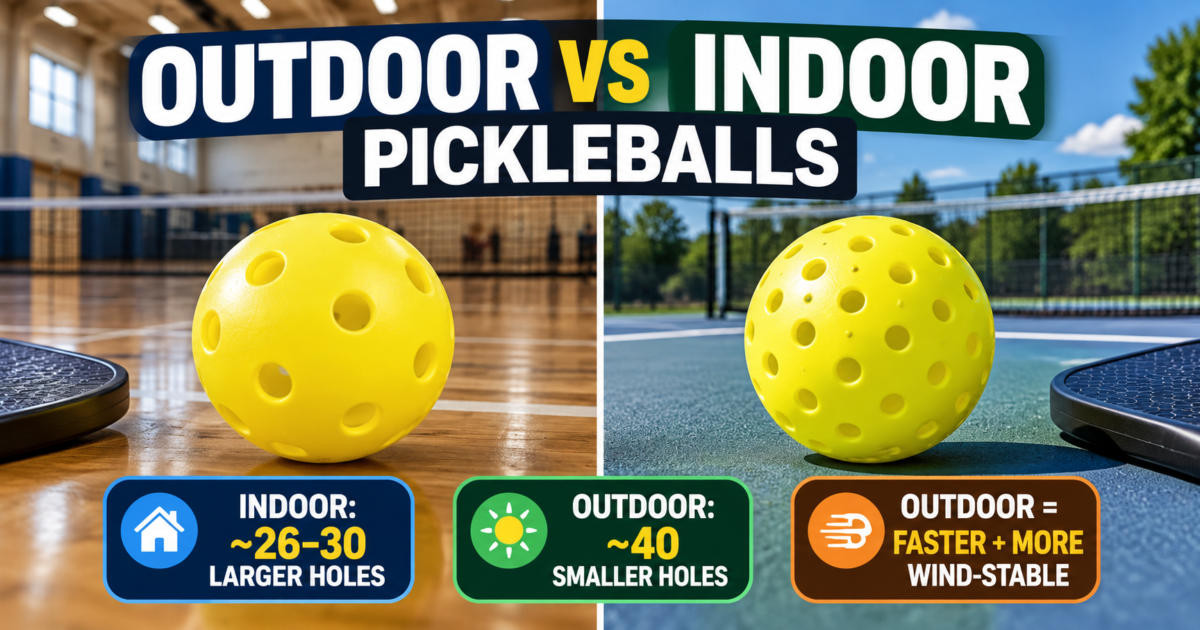
Outdoor vs indoor pickleballs differ mainly in hole pattern, weight, hardness, speed, and wind resistance. Indoor balls typically use fewer, larger holes and play softer and slower. Outdoor balls typically use more, smaller holes and a firmer build that holds a faster, steadier flight outside.
Outdoor vs indoor pickleballs: the specs
Both ball types have to fit USA Pickleball’s equipment standards to be legal for sanctioned play: 26 to 40 circular holes, a diameter of 2.87 to 2.97 inches, and a weight between 0.78 and 0.935 ounces, according to Wikipedia. Inside that shared range, indoor and outdoor models are built to behave very differently once they’re in play.
| Feature | Indoor pickleball | Outdoor pickleball |
| Typical hole count | ~26–30 | ~40 |
| Hole size | Larger | Smaller |
| Feel | Softer | Harder |
| Weight | Usually lighter | Usually heavier |
| Game speed | Slower | Faster |
| Wind resistance | Lower | Higher |
| Best surface | Indoor gym floors | Outdoor hard courts |
| Common wear pattern | Softening, deformation | Cracking, surface wear |
USA Pickleball’s approved-ball database also lists indoor/outdoor (I/O) hybrid models, so ball makers now build for players who split time between both surfaces rather than only one.
How hole count and size change the flight
Holes are the fastest way to tell two balls apart on sight. Indoor pickleballs commonly carry around 26 larger holes, while outdoor models often carry closer to 40 smaller holes, according to Forbes.
More surface area from larger holes means more drag, which is why indoor balls fly slower and tend to be easier to place on soft dinks. Outdoor balls trade that control for stability: their smaller-hole, firmer build keeps flight more predictable once wind enters the equation.
Hole count isn’t a fixed rule, though. Some current outdoor balls skip the traditional 40-hole layout entirely and still meet USA Pickleball’s 26-to-40 range.
Speed: which ball plays faster
Outdoor pickleballs play faster as a rule. Their firmer plastic and slightly higher weight let them cut through the air with less disruption, while indoor balls run softer and slower through a rally.
That speed gap changes shot selection directly. An outdoor ball reaches the kitchen line faster on a drive or speed-up, so reaction time at the net matters more. An indoor ball’s slower pace gives newer players extra time to set up their paddle contact, and it tends to produce longer rallies since both sides have more time to reposition between shots.
Wind: which ball holds its line
Outdoor pickleballs handle wind better. The combination of smaller holes, more weight, and a firmer shell resists gusts more than an indoor ball’s lighter, softer build. Wind can still push either ball off course, so shortening lobs and adding extra margin on serves and drives helps regardless of which ball is in play. What changes with an outdoor ball is how much correction you need to make, not whether correction is needed at all.
Durability: which ball lasts longer
Ball life depends on the specific ball, court temperature, surface, and how hard players are hitting — but the two types tend to fail differently. Outdoor balls are built for asphalt and concrete, and their harder plastic can crack under impact, especially in cold weather. Indoor balls face smoother gym floors and hold their shape for longer, but softer plastic can warp or go slightly out-of-round over time instead of cracking.
Replace a ball once it:
- Develops a visible crack
- Goes noticeably out of round
- Shows heavy surface wear
- Starts bouncing inconsistently
- Flies unpredictably off the paddle
In short: outdoor balls tend to crack before they lose shape, while indoor balls tend to warp before they crack.
Can you use either ball on either court?
Yes — nothing stops you from playing an indoor ball outside or an outdoor ball inside. The reason to match ball to environment is performance, not a hard rule.
Pick an indoor ball for:
- Slower ball speed
- A softer feel off the paddle
- Easier control for newer players
- Smooth indoor gym floors
Pick an outdoor ball for:
- Faster flight
- Better wind stability
- A firmer bounce and feel
- Longer life on rough outdoor courts
Some indoor facilities run outdoor-style hard court surfaces and choose outdoor balls to match, so the surface itself can matter as much as whether there’s a roof overhead. For league or tournament play, check which specific ball model the event has approved before you show up with your own.
FAQ
How can you tell indoor and outdoor pickleballs apart?
Start with the holes. Indoor balls generally have fewer, larger holes; outdoor balls generally have more, smaller ones — though some newer designs don’t follow the traditional 26-hole or 40-hole pattern exactly.
Are outdoor pickleballs heavier?
Usually, yes, by a small margin. The extra weight helps stability outside, but every competition-approved ball still has to stay within the 0.78-to-0.935-ounce range.
Do outdoor pickleballs have 40 holes?
Many do, but 40 isn’t required. Approved balls can have anywhere from 26 to 40 circular holes, so some outdoor models use fewer holes and still meet the standard.
Are there pickleballs made for both indoor and outdoor use?
Yes. Several manufacturers sell dual-purpose (I/O) balls aimed at players who move between both environments regularly.
Choosing between them
The real outdoor vs indoor pickleballs difference comes down to how each ball is built for its court: indoor balls are built for slower, softer, more controlled play, and outdoor balls are built for speed and wind stability. Match the ball to where you’re actually playing, and the game gets a lot more predictable.