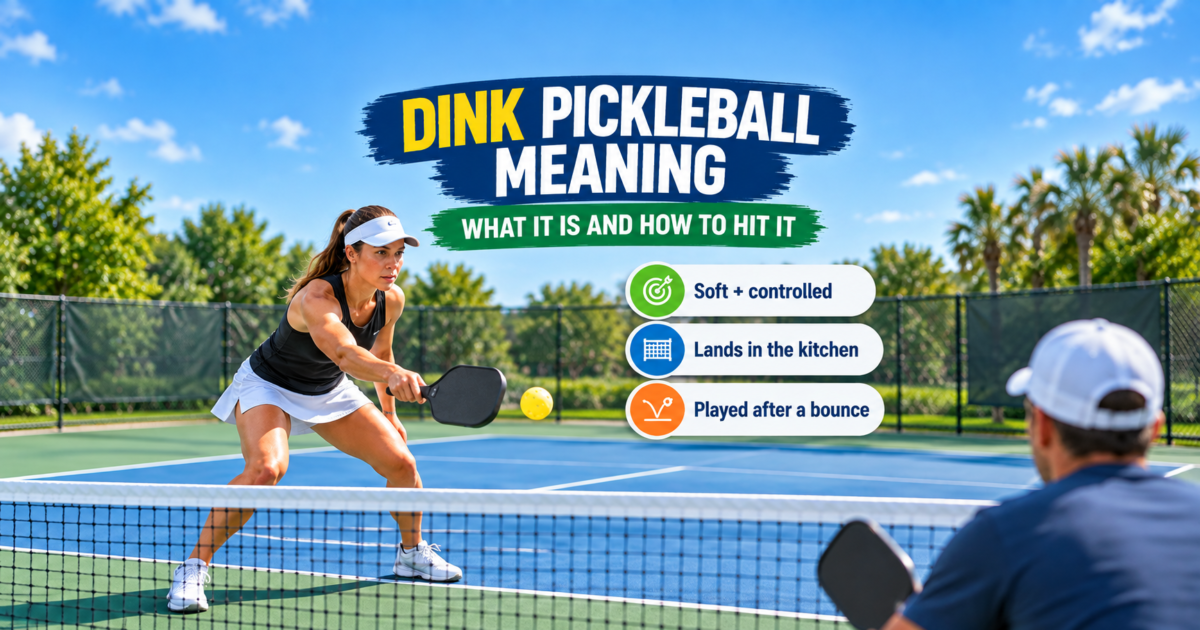
The dink pickleball meaning is simple: a dink is a soft, controlled shot that travels over the net and lands in your opponent’s non-volley zone, commonly called the kitchen. It is usually played after the ball bounces and is designed to stay low enough that your opponent cannot easily attack it.
Dinking is, according to The Guardian, one of pickleball’s most important skills because it replaces power with placement, patience, and control.
Dink pickleball meaning explained
A dink is a soft shot normally played from near the kitchen line. The ball is hit after a bounce, travels just over the net, and drops into the opponent’s non-volley zone.
The goal is not to hit a winner immediately. Instead, you are trying to make the next ball difficult for your opponent to attack.
A good dink:
- Clears the net safely
- Lands inside the opponent’s kitchen
- Stays relatively low after bouncing
- Forces the opponent to hit upward
- Reduces the effectiveness of hard drives and smashes
The shot becomes especially important once players reach the kitchen line.
Why do players dink in pickleball?
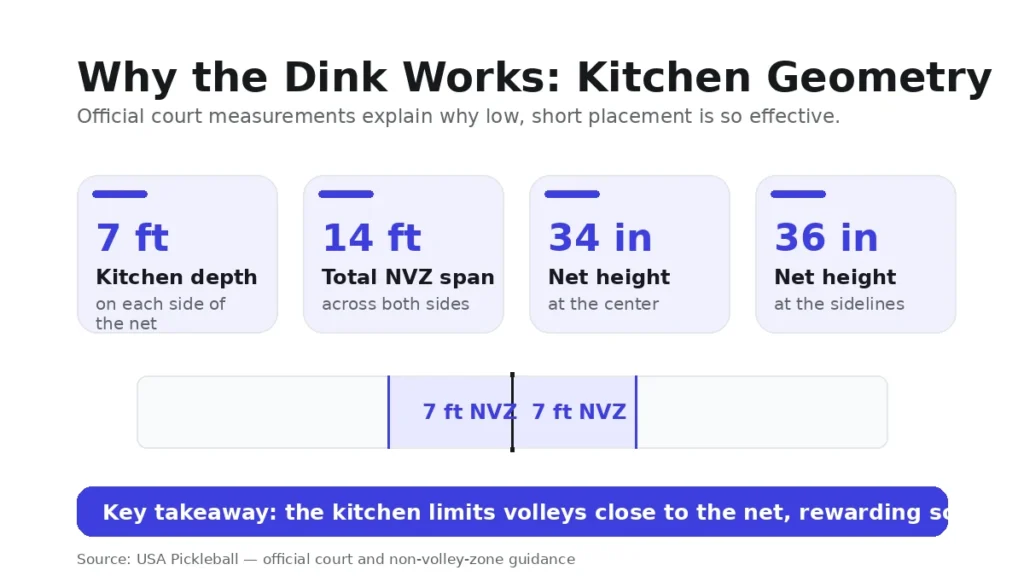
Players dink because the non-volley zone rules make low, short balls difficult to attack.
According to Wikipedia, the kitchen extends 7 feet from the net on each side. Players cannot volley while standing in the non-volley zone or touching its boundary lines.
If your dink lands short and stays low, your opponent generally has to let the ball bounce before returning it. That makes it harder to hit a powerful downward shot.
Dinking can therefore help you:
- Slow down a fast rally
- Neutralize an aggressive opponent
- Move an opponent out of position
- Create an attackable high ball
- Avoid giving your opponent an easy smash
The dink is a fundamental tactical shot because the non-volley zone prevents players from simply standing next to the net and attacking every ball.
How to hit a dink
A consistent dink uses a compact, controlled motion rather than a large swing.
Start near the kitchen line with your knees slightly bent and your paddle in front of your body. Let the ball bounce, then contact it in front of you.
Use these basic steps:
- Keep a relaxed grip. A tight grip can send the ball too far or too high.
- Open the paddle face slightly. This helps lift the ball over the net.
- Use a short motion. Push or lift the ball instead of taking a full backswing.
- Contact the ball in front. This provides better control over height and direction.
- Recover quickly. Return your paddle to a ready position for the next shot.
The motion should be gentle and controlled, with most of the movement coming from the shoulder rather than a large wrist flick.
Where should a dink land?
A dink should normally land inside the opponent’s kitchen, preferably in a position that makes the next shot uncomfortable.
There are two common placements.
Straight-ahead dink: You hit the ball toward the opponent directly across from you. The distance is shorter, so controlling net clearance is especially important.
Crosscourt dink: You hit diagonally toward the opposite side of the kitchen. The diagonal court provides more distance, while the net is lower near the middle.
Crosscourt placement can also pull an opponent away from the center and create an opening for the next shot.
Placement matters more than speed. A low dink near an opponent’s feet can be much more effective than a harder shot that sits high after bouncing.
Dink vs drop shot
A dink and a drop shot are both soft shots, but they are normally used from different areas of the court.
| Shot | Typical starting position | Intended landing area | Main purpose |
| Dink | Near the kitchen line | Opponent’s kitchen | Continue or control a soft exchange |
| Drop shot | Farther from the net | Opponent’s kitchen | Allow the hitting team to move toward the net |
A third-shot drop is a common example of a drop shot. Once players establish themselves near the kitchen line, those soft exchanges are generally referred to as dinking.
Common dink mistakes
One common mistake is hitting the ball too high. A high dink can give an opponent the opportunity to attack downward.
Other frequent problems include:
- Swinging too hard
- Using excessive wrist movement
- Standing too upright
- Trying to hit every dink for a winner
- Allowing the ball to get too close to the body
- Aiming too close to the sideline without enough margin
Patience is a major part of successful dinking. The purpose is often to wait for your opponent to make a mistake or leave a ball high enough to attack.
Dink pickleball FAQs
Does a dink have to bounce?
A traditional dink is played after the ball bounces. It is a soft shot made from near the non-volley zone that clears the net and drops into the opponent’s kitchen.
Can you dink from inside the kitchen?
Yes. You can legally stand inside the kitchen and hit a ball after it has bounced. The restriction applies to volleys rather than groundstrokes played after a bounce.
Why is it called a dink?
“Dink” is the established pickleball term for this soft, short shot. The official rules focus on how the shot is played rather than establishing a formal origin for the nickname.
Is dinking important for beginners?
Yes. Learning to dink helps beginners develop touch, control, patience, and confidence near the non-volley zone instead of relying entirely on hard shots.
Conclusion
Understanding the dink pickleball meaning helps explain much of pickleball’s strategy. A controlled dink lands softly in the kitchen, limits aggressive returns, and creates opportunities through placement and patience rather than power.