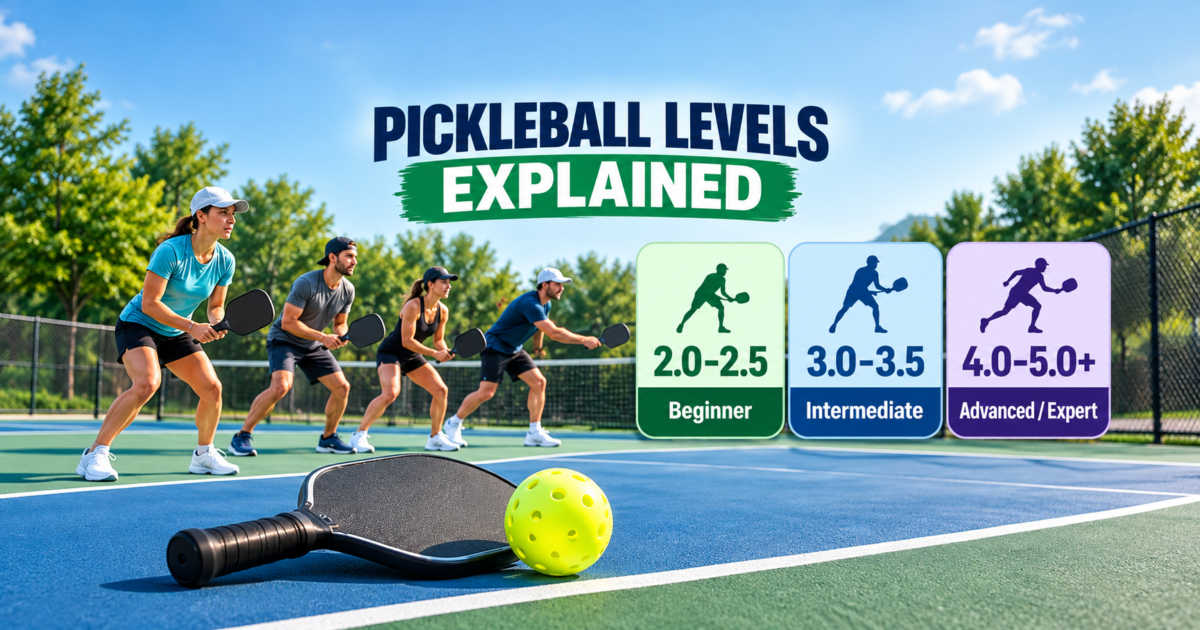
Pickleball levels describe a player’s ability based on shot control, consistency, court positioning, strategy, and match performance. Players commonly progress from beginner levels around 2.0-2.5 through intermediate 3.0-3.5, advanced 4.0-4.5, and expert levels of 5.0 or higher.
Understanding your level helps you find suitable partners, enter the right tournaments, and identify which parts of your game need improvement.
What are pickleball levels?
Pickleball levels are ratings used to group players with similar abilities, according to Wikipedia. USA Pickleball’s skill-level guidance assesses areas such as forehands, backhands, serves and returns, dinks, third shots, volleys, and strategy.
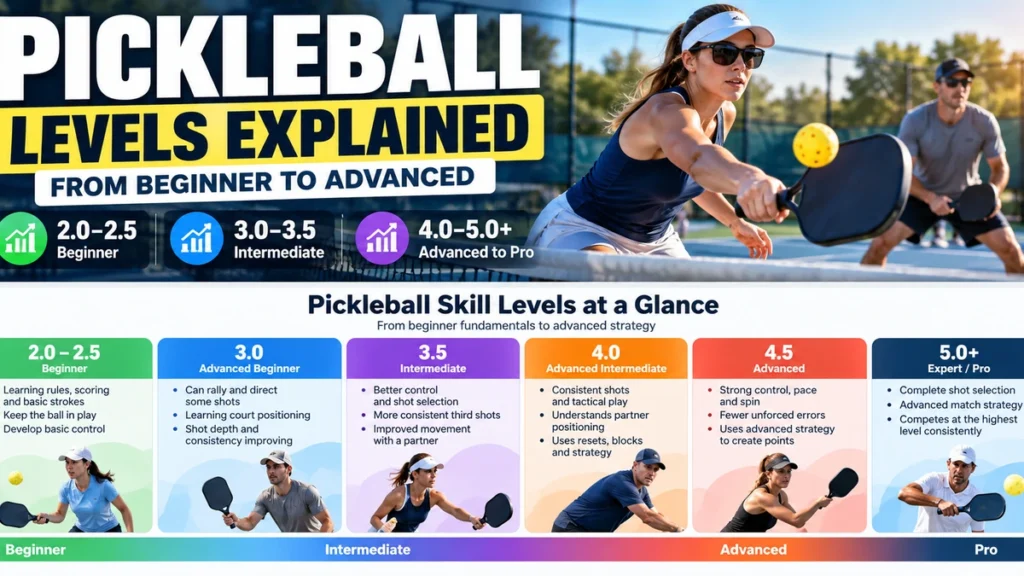
A simple breakdown looks like this:
| Pickleball level | General ability | Typical characteristics |
| 2.0-2.5 | Beginner | Learning rules, scoring, and basic strokes |
| 3.0 | Advanced beginner | Can rally and direct some shots |
| 3.5 | Intermediate | Better control, positioning, and shot selection |
| 4.0 | Advanced intermediate | Consistent shots and stronger tactical play |
| 4.5 | Advanced | Strong control, pace, spin, and strategy |
| 5.0+ | Expert | Complete shot selection and advanced match strategy |
These categories are useful for describing playing ability, while systems such as DUPR use actual match results to produce a numerical rating.
Pickleball level 2.0 to 2.5
A 2.0 or 2.5 player is still developing the fundamentals.
USA Pickleball describes a 2.5 player as someone with limited experience who can maintain a short rally against players of similar ability and has a basic ability to keep score.
Players at this stage should focus on:
- Consistently getting serves in
- Returning serves deep
- Keeping short rallies alive
- Learning the non-volley zone rules
- Understanding scoring
- Developing basic forehand and backhand control
Winning should be less important than keeping the ball in play and building repeatable strokes.
What is a 3.0 pickleball player?
A 3.0 player has moved beyond the earliest beginner stage and can play competitive games with a basic understanding of positioning.
USA Pickleball’s matrix says a 3.0 player can hit medium-paced shots with some directional intent, sustain a basic dink rally, and is learning proper court positioning. Shot depth and consistency still need work.
At this level, players begin learning when to use a third-shot drop instead of simply hitting every ball hard.
DUPR also describes a 3.0 player as an intermediate-level pickleball player.
What is a 3.5 pickleball level?
The 3.5 range is where strategy becomes increasingly important.
A player around this level generally has better control over serves, returns, dinks, volleys, and groundstrokes. Instead of simply reacting to the ball, the player starts constructing points and recognizing attackable balls.
Typical improvements include:
- More dependable third shots
- Longer dink rallies
- Better movement with a doubles partner
- Fewer unforced errors
- Greater control of shot direction
- Improved transition to the kitchen line
The biggest difference from lower levels is usually consistency rather than raw power.
What is a 4.0 pickleball player?
A 4.0 player has reliable strokes and understands how to use them strategically.
USA Pickleball says players at this level can consistently hit forehands with depth and control, place a high percentage of serves and returns with varying depth and speed, and use different types of volleys. They also understand partner positioning and can change shot direction offensively.
A 4.0 player is also becoming comfortable with techniques such as resets, blocks, stacking, and coordinated movement at the non-volley zone.
At this point, opponents punish weak returns and poorly placed balls much more often.
Pickleball levels 4.5 and 5.0+
Players at 4.5 and above combine technical ability with advanced tactical decisions.
At 5.0, USA Pickleball expects players to hit a wide range of shots using touch, spin, pace, and placement. They can use third-shot drops and drives consistently, turn defensive situations into offensive opportunities, and adjust strategy according to an opponent’s strengths and weaknesses.
USA Pickleball classifies 5.5+ players as top-caliber competitors whose performance and tournament results demonstrate their ability to compete consistently at a high level.
Pickleball levels vs DUPR ratings
Skill descriptions and DUPR ratings serve related but different purposes.
Traditional skill levels can help players assess abilities such as dinking, volleying, serving, and strategy. DUPR uses recorded match results to create a dynamic numerical rating.
DUPR currently uses a 2.000 to 8.000 scale, as reported by Forbes, with new players starting as NR, meaning Not Rated. Ratings change as additional match results are recorded.
DUPR broadly groups its scale as:
- 2.00-2.99: Beginner to early intermediate
- 3.00-3.99: Intermediate
- 4.00-4.99: Advanced
- 5.00-8.00: Elite to professional
The system considers match performance, match type, number of matches, and recency when updating ratings.
USA Pickleball and DUPR announced in December 2025 that DUPR would become the official exclusive rating system for USA Pickleball-owned events, making DUPR increasingly relevant for competitive players.
How to find your pickleball level
Start by comparing your abilities with established skill-level descriptions rather than rating yourself according to wins against friends.
Consider whether you can consistently:
- Serve and return with depth
- Sustain dink rallies
- Execute third-shot drops
- Control volleys
- Limit unforced errors
- Move correctly with a partner
- Change strategies during a match
For an objective rating, playing recorded matches through DUPR provides a score based on match performance rather than self-assessment. DUPR notes that a larger match history makes a rating more accurate and stable.
Pickleball levels FAQs
Is 3.0 good in pickleball?
Yes. A 3.0 player has progressed beyond basic beginner play and can compete while developing greater shot consistency, positioning, and strategy.
What is considered intermediate pickleball?
Players around the 3.0-3.5 range are commonly considered intermediate, although exact labels vary between rating systems.
What level is an advanced pickleball player?
A player around 4.0-4.5 is generally considered advanced, with consistent strokes, stronger court awareness, and the ability to use strategy instead of relying mainly on keeping the ball in play.
What is the highest pickleball level?
Traditional skill descriptions extend to 5.5+ for top-caliber players, while the current DUPR numerical rating scale extends as high as 8.000.
Conclusion
Pickleball levels provide a clear way to measure progress from beginner fundamentals to advanced competitive play. Knowing your pickleball level helps you choose suitable opponents, enter appropriate events, and focus practice on the skills needed to improve.