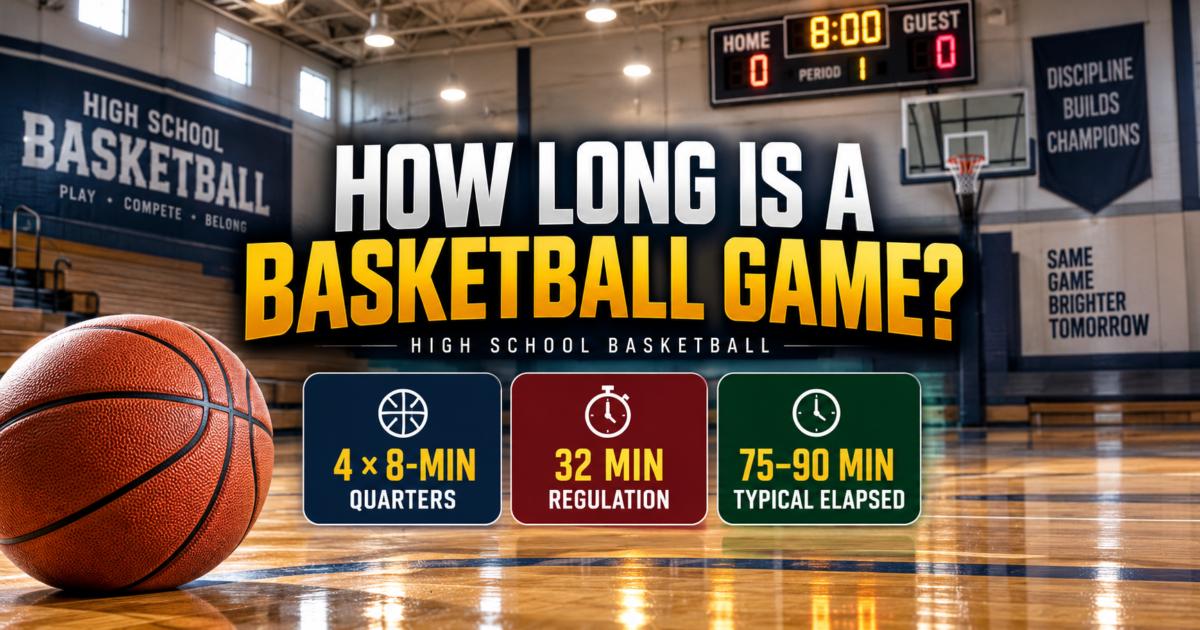
A standard answer to how long is a basketball game in high school is 32 minutes of regulation playing time, split into four 8-minute quarters, according to ESPN. In real time, however, most varsity games take about 75 to 90 minutes because the clock stops for fouls, free throws, timeouts, quarter breaks, halftime, and other delays.
How long is a basketball game in high school?
A regulation high school basketball game has four 8-minute quarters, giving players 32 total minutes of scheduled game time. NFHS timing guidance also provides a 10-minute halftime, with short intermissions after the first and third quarters.
Here is the basic format:
| Part of game | Length |
| First quarter | 8 minutes |
| Second quarter | 8 minutes |
| Halftime | 10 minutes |
| Third quarter | 8 minutes |
| Fourth quarter | 8 minutes |
| Regulation playing time | 32 minutes |
| Overtime | 4 minutes each |
The 32-minute total refers only to time shown on the game clock. A spectator should plan for considerably more than 32 minutes from the opening tip to the final buzzer.
Why do games take 75–90 minutes?
The game clock stops regularly during a high school basketball game. That makes elapsed time much longer than the official 32 minutes.
Common causes include:
- Personal fouls
- Free throws
- Team timeouts
- Balls going out of bounds
- Violations
- Injuries
- Officials discussing a call
- Quarter breaks
- Halftime
- Overtime
Basketball for Coaches estimates that a high school game lasts around 1.5 hours, while Under Armour similarly places a typical game near 90 minutes. HoopsKing gives a general range of about one hour and 15 minutes to one hour and 30 minutes.
A close game can take longer because teams often foul intentionally late in the fourth quarter, coaches use remaining timeouts, and players shoot more free throws.
How long is high school overtime?
High school basketball overtime periods are generally 4 minutes long under NFHS timing rules, as reported by Sporting News. If the score remains tied after one overtime, another overtime period can be played until one team finishes an extra period ahead.
A game that goes to overtime therefore has at least 36 minutes of playing time instead of 32.
The actual added time is longer than four real-world minutes because the clock can still stop for fouls, free throws, timeouts, violations, and other dead-ball situations.
NFHS also updated its timing provisions for the 2026-27 season. During the final 59.9 seconds of a quarter or overtime period, at least 0.3 seconds must run off the game clock after the ball is legally touched inbounds following certain resumptions of play, provided the clock can display tenths of a second.
Can a running clock shorten games?
Yes. Some state high school associations use running-clock or mercy-rule procedures when one team builds a large lead.
These rules are not identical nationwide. The score differential, point in the game when the running clock starts, and situations that stop the clock can depend on the state association.
For example, Illinois has used a basketball mercy rule in which a 30-point fourth-quarter differential triggers a running clock under specified conditions. Other states have adopted different thresholds or procedures.
Because the clock stops less often under these rules, a one-sided game can finish considerably faster than a close contest played with normal timing.
Do JV games have shorter quarters?
They can. Varsity high school games normally use 8-minute quarters, but lower-level contests may use shorter periods depending on state or local rules.
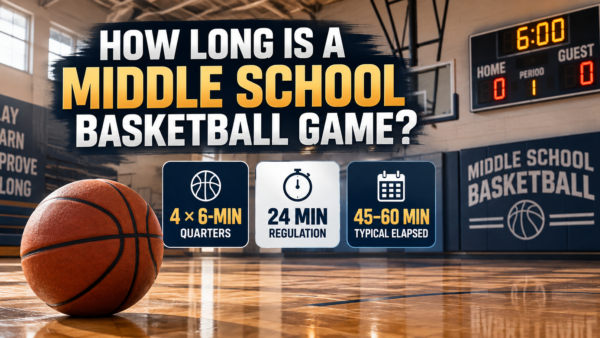
NFHS timing guidance notes that teams younger than high-school age may use four 6-minute quarters, and shortened periods can also affect the length of overtime.
That means families should check the school, conference, tournament, or state association rules if they are attending a freshman, junior varsity, or younger-level game.
What makes a game last longer?
The biggest factor is the number of clock stoppages.
A game with few fouls and limited timeouts can move quickly. A close fourth quarter may add substantial time because teams can intentionally foul to stop the clock and force free throws.
Other factors include:
- Multiple overtime periods
- Frequent free throws
- Injuries
- Clock corrections
- Long discussions between officials
- Teams using most of their available timeouts
NFHS’s 2026-27 rules specifically address game-clock corrections and timing errors, showing how closely officials must manage the clock near the end of quarters and overtime periods.
High school basketball game FAQs
How many minutes are in a high school basketball game?
A varsity high school basketball game has 32 minutes of regulation playing time, divided into four 8-minute quarters. Breaks and clock stoppages make the actual event much longer.
How long should I plan to be at the gym?
Plan for roughly 75 to 90 minutes for a typical varsity game. Arriving early for warmups or staying through overtime can extend the total visit.
How long is halftime in high school basketball?
High school basketball halftime is normally 10 minutes under NFHS timing guidance.
How long is high school basketball overtime?
A standard high school basketball overtime period lasts 4 minutes. Additional overtime periods can be played if the score remains tied.
Conclusion
So, how long is a basketball game in high school? Regulation lasts 32 minutes, but a normal varsity contest usually occupies about 75 to 90 minutes once halftime, fouls, timeouts, and other stoppages are included.