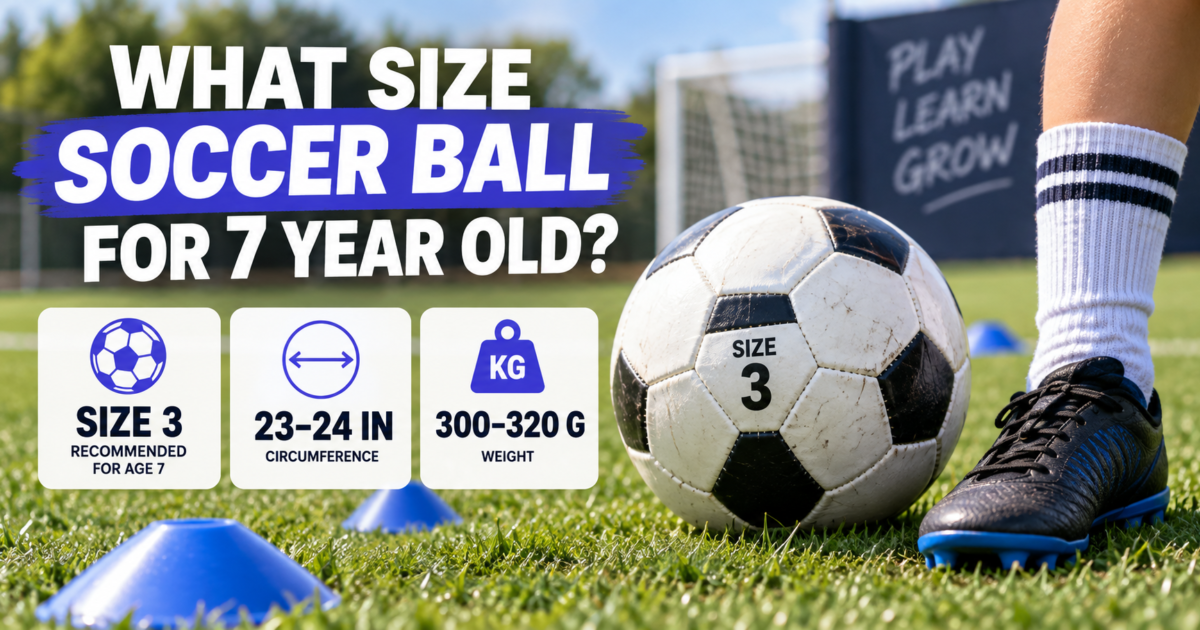
The answer to what size soccer ball for 7 year old is a size 3. A size 3 ball measures 23 to 24 inches around, weighs 300 to 320 grams, and suits most players under age 8. It matches a young player’s foot size, leg strength, and coordination level. Some leagues allow size 4 early, so confirm the rule with your coach before buying.
What size soccer ball for 7 year old?
Size 3 is the standard because it matches how a 7 year old’s body works right now. A size 5 adult ball weighs 410 to 450 grams, according to FIFA, nearly 100 grams more than a size 3. For a child who might weigh 22 to 27 kilograms, that extra weight forces harder kicks and sloppier technique.
Circumference matters just as much. At 23 to 24 inches, a size 3 ball rolls cleanly under a 7 year old’s foot during dribbling drills. A size 4 ball, at 25 to 26 inches, forces wider touches and slows control development. Youth coaches consistently see kids who train with size 3 build a cleaner first touch than kids pushed to size 4 too soon.
Soccer ball size chart by age
| Size | Typical Age | Circumference | Weight | Typical Use | Recommended PSI |
| 1 | Under 3 | 18–20 in | 200–240 g | Skills, souvenirs | 4–6 |
| 2 | 3–5 | 20–22 in | 250–280 g | Skills, intro play | 4–6 |
| 3 | 6–8 | 23–24 in | 300–320 g | U6–U8 matches | 8–10 |
| 4 | 9–11 | 25–26 in | 350–390 g | U9–U12 matches | 8–10 |
| 5 | 12+ | 27–28 in | 410–450 g | U13+, adult | 8–12 |
Most 7 year olds have already outgrown size 2. That size is really a bridge for 3 to 5 year olds who are just learning to kick, so skip it if your child has played any organized soccer.
When a 7 year old needs size 4
A physically advanced 7 year old, one above the 90th percentile for height and weight, can sometimes handle a size 4 without trouble. But size alone doesn’t decide it. Skill level matters more. A child with two or three seasons of experience, accurate passing, and confident trapping might be ready to move up early.
League age group overrides calendar age. If your 7 year old plays up on a U9 team, they use whatever ball that team uses, usually size 4, even in practice. If the league mandates size 3 for U8, that is what your child plays with in matches, no exceptions.
Signs your child is ready for size 4:
- Controls a size 3 ball comfortably at speed during dribbling drills
- Passes travel 10 to 15 yards with accuracy and proper technique
- Traps the ball cleanly without it bouncing away
- Kicks show consistent power without straining
If your child struggles with any of these on a size 3, moving up early can stall progress rather than speed it up.
How to confirm your league’s ball size rule
League rules vary more than most parents expect. US Youth Soccer recommends size 3 for U6 through U8, but local organizations set their own standards. Some rec leagues use size 3 for U8 and size 4 for U9. AYSO follows size 3 for U8 and under, though some competitive clubs introduce size 4 in U8 training even when matches still use size 3.
Ask your coach or league administrator:
- What size ball is used for U7 or U8 matches in this league?
- Is there a different size for practice versus games?
- Does the team supply balls, or do we need our own?
- Are there brand or material restrictions?
Most leagues post this in their welcome packet or registration page. A quick email settles it in minutes and saves you from buying the wrong ball twice.
How to buy a size 3 ball
A 7 year old doesn’t need a 60 dollar match ball. They need something durable enough for driveways and grass, soft enough for safe practice, and cheap enough that losing it doesn’t sting.
Youth balls come in three cover materials. PVC is the cheapest, with a harder surface and less touch sensitivity, fine for casual play. TPU sits in the middle, softer than PVC and more durable than PU, and offers the best value for a child who practices regularly. PU is the softest and most responsive but wears faster on rough surfaces, worth it only if your child plays on good grass.
Keep pressure at 8 to 10 PSI. Overinflated balls feel hard and can sting on contact, which discourages heading and trapping. Underinflated balls roll sluggishly and build bad habits. Expect to spend 15 to 40 dollars for a quality youth ball. Below 10 dollars, durability drops fast. Above 40 dollars, you’re paying for features a 7 year old won’t notice.
Frequently asked questions
Is a size 3 ball too small for a 7 year old?
No. Size 3 is the correct size for most 7 year olds, matching both their physical development and league standards. Only exceptionally large or advanced players should consider size 4 early.
Can a 7 year old use a size 4 ball?
Yes, if the league allows it and the child shows readiness. Most leagues use size 3 for U8 and under, so confirm first before assuming a size 4 is fine.
What is the difference between size 3 and size 4?
Size 3 is 23 to 24 inches around and weighs 300 to 320 grams. Size 4 is 25 to 26 inches and 350 to 390 grams, making it heavier, larger, and faster off the foot.
What PSI should a size 3 soccer ball be?
A size 3 ball should sit at 8 to 10 PSI. Check it with a gauge before practices and games, since overinflation makes the ball hard and uncomfortable to kick.
Bottom line
Buy a size 3 ball for a 7 year old. It fits most U7 and U8 leagues, supports proper technique, and costs 15 to 40 dollars. Confirm your league’s rule, then inflate to 8 to 10 PSI before the first practice.